Devrazzi
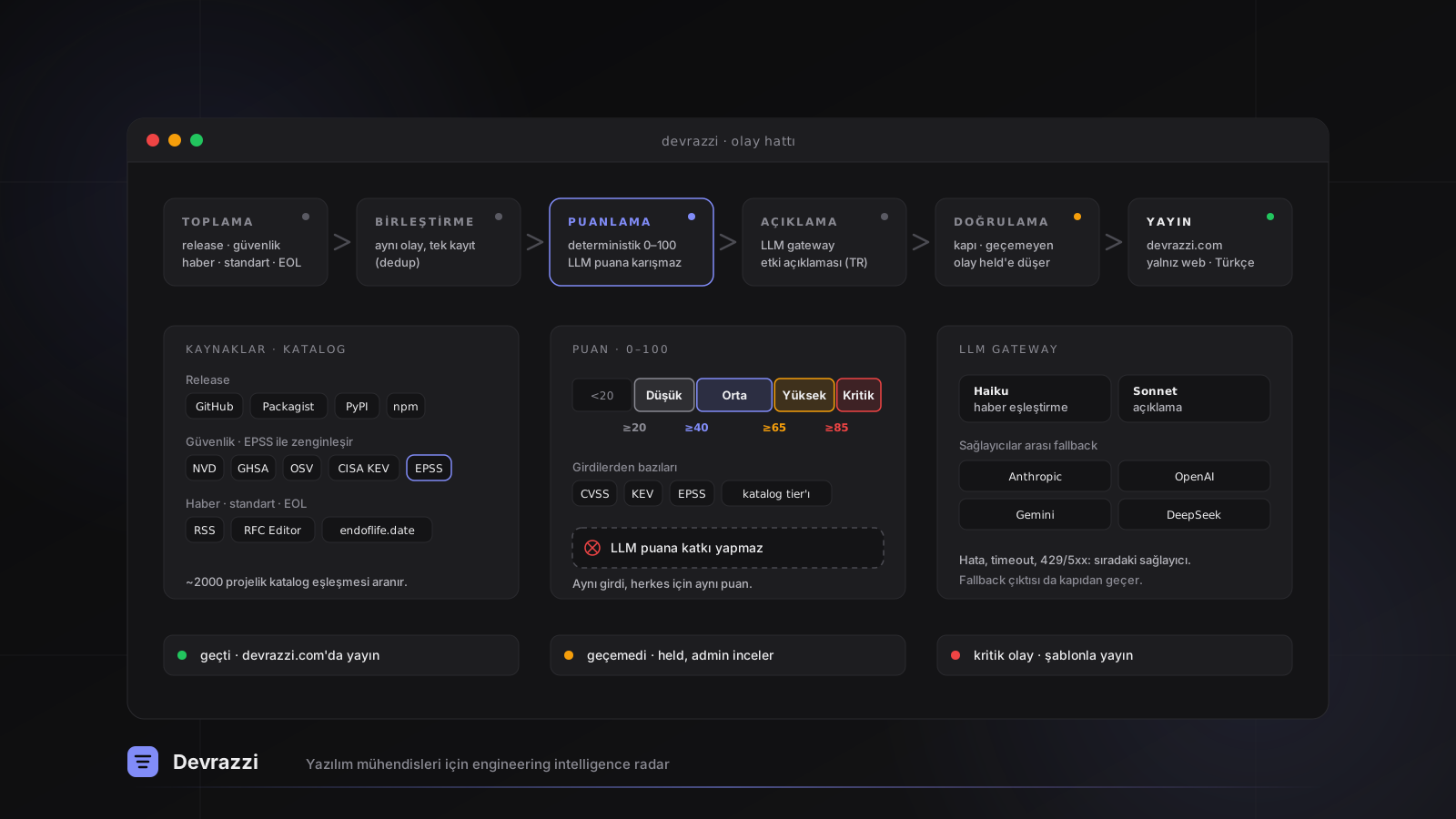
Ongoing Side PublicationsDevrazzi is an engineering intelligence radar for software engineers. It tracks releases, security vulnerabilities (CVE/NVD, GHSA, OSV, CISA KEV), deprecation and EOL announcements, and RFCs, merges records describing the same event, gives every event a 0-100 score with a deterministic formula and explains the impact in Turkish. The language model makes no contribution to the score; it only writes the explanation, and no explanation is published until it passes citation, CVE, version and package validation. It is published on the web only and in Turkish only.
- Role
- Founder & Developer
- Duration
- October 2026 — Ongoing
Technologies
Skills
Devrazzi is an engineering intelligence radar I built to track meaningful changes across the software ecosystem. It tracks the releases in a catalogue of about 2000 projects, CVE/NVD, GitHub Security Advisories and OSV records, the CISA KEV list, deprecation and EOL announcements, and RFCs; records describing the same event are merged into a single event. Every event is scored from 0 to 100 by a deterministic formula and falls into the Critical, High, Medium or Low band; the components of the score are visible on every event page and the rules are written at devrazzi.com/puanlama. The score is the same for everyone; the user only filters. The product is published on the web only and in Turkish only.
I deliberately kept the language model’s role narrow: it makes no contribution to the score, it only writes the Turkish explanation of the impact. A Haiku-class model matches news to events and a Sonnet-class model writes the explanation; in the Low band no model is called for the explanation, and the explanation is built from the sources with a fixed template. Calls go through a single gateway, and every job type has its own provider order and fallback chain; the target for monthly LLM spend is 100-300 USD, and the ceiling is enforced with a counter in PostgreSQL. Every explanation passes a validation gate before it is published: it must cite at least one source, and the CVE, version and package names it uses must appear in the source text. An event that fails drops into review; a Critical event, though, is published with a template noted as automatically generated.
This architecture is a concrete example of what I do and don’t have the model do in an AI-assisted system. It is built on Laravel, with PostgreSQL and RabbitMQ; it was rewritten from scratch on 13 October 2026 and went live on 14 October 2026. I’m leaving a known limit open: the model’s capped contribution to the score is off, because it did not clear the measurement threshold on the golden set; as a result, deprecation, EOL and RFC events are tracked but stay below the publishing threshold today. The next job is to improve agreement on deprecation detection and measure the contribution again.