SignalLock
Ongoing Older / Hobby ProjectsSignalLock is a privacy-focused menu bar and system tray app that automatically locks your computer when you walk away from it — using a Bluetooth device you carry with you. It runs on macOS, Windows and Linux from a single Rust codebase.
- Role
- Owner
- Duration
- May 2026 — Ongoing
Technologies
Skills
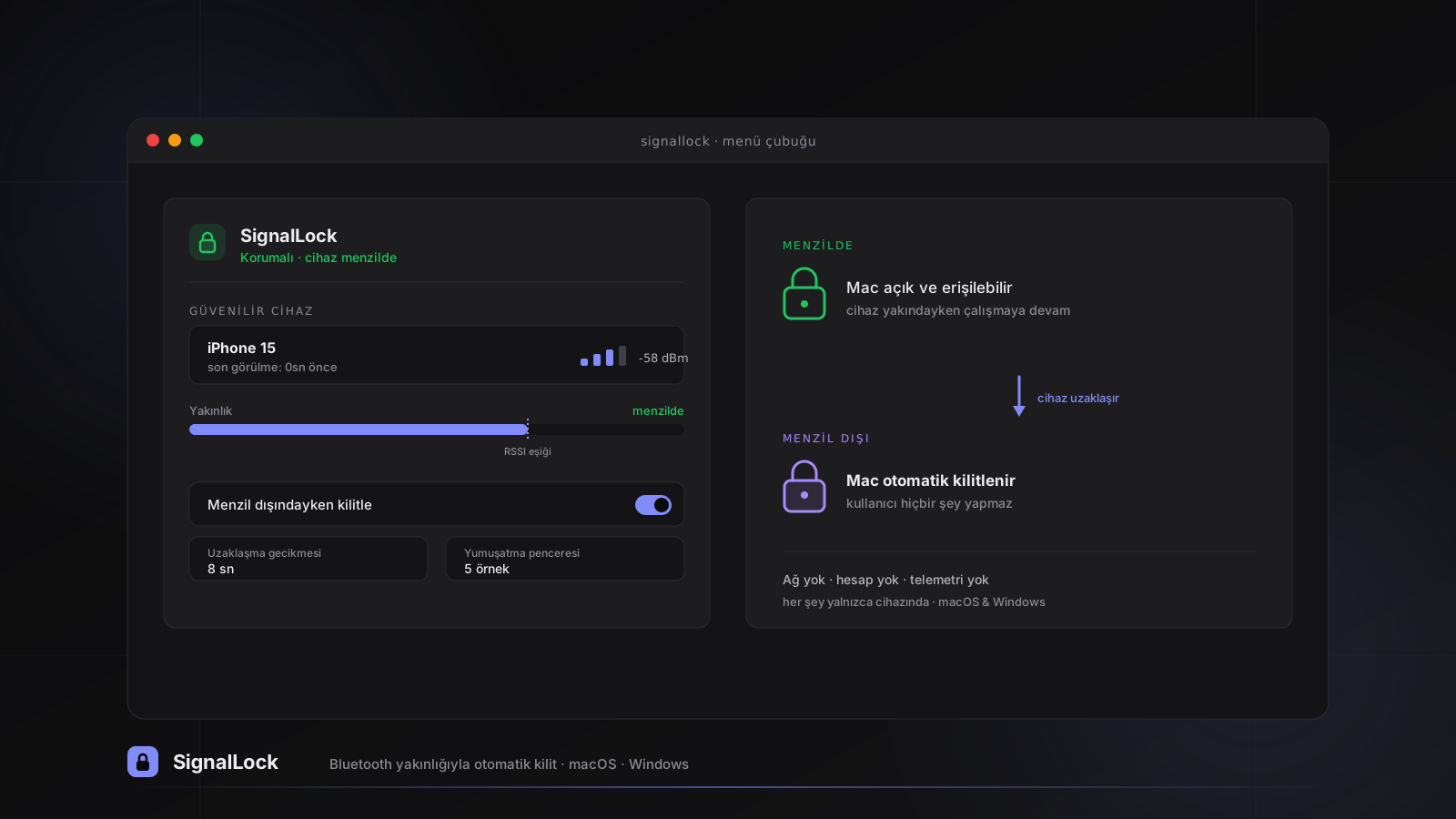
SignalLock is a desktop security tool I built for users who walk away from their desk and forget to lock their computer. In shared environments such as coworking spaces, cafés, libraries, or open offices, an unlocked computer is a serious privacy risk. SignalLock solves this problem by designating a Bluetooth device the user already carries (a phone, a smartwatch, earbuds, or a BLE tag) as a trusted device. When that device leaves range, the computer locks itself; the user has to do nothing. The app runs in the menu bar or the system tray on macOS, Windows and Linux.
At the technical heart of the app is a proximity algorithm that, instead of simple “device present/absent” logic, combines a smoothed RSSI signal strength with a last-seen timestamp. This approach prevents the momentary fluctuations inherent to Bluetooth signals from causing false locks. The RSSI threshold, the away delay, and the smoothing window can be adjusted by the user; the defaults (-80 dBm, 20 seconds, 5 samples) are deliberately chosen to be conservative in order to minimize false locks.
All three platforms are built from a single Rust codebase. The proximity engine, the settings models and the JSON layer that stores the settings live in a separate crate that touches no platform API. Bluetooth scanning (btleplug), the tray menu, the settings windows written in Slint and the screen lock live in a second crate. Locking uses each operating system’s own mechanism. SignalLock only locks; unlocking stays with the system’s own authentication. The app ships as a .dmg for macOS, an installer for Windows and an AppImage for Linux, and its source code is open under the GPL-3.0 license.
The most important principle that sets SignalLock apart from similar solutions is privacy. The app makes no network request on its own; it includes no backend server, cloud sync, account system, telemetry, or analytics. The only connection it opens is the update check the user starts from the menu: the request goes to GitHub, and the downloaded package is verified with SHA-256 before it is installed. It does not use location services, and all settings are stored only on the user’s own machine. As a result, unlike cloud-based “find my desk” solutions, the user gets a similar convenience without sending device or usage data to a server. A simple landing page with TR/EN language support rounds out the project.