5 sections
The Cost of Deferring an Upgrade
A PHP 7.1 → 8.2 upgrade was put off because "it works." The bill came later: a dependency lock, batched breaking changes, and bugs spread over months.
Series
For tech leads and engineers who own runtimes, frameworks and dependencies that must be upgraded without breaking production. The problem is that an upgrade is a risk decision, not a calendar task. The parts are published weekly and follow the order in which the decision is made: the cost of deferring, triggers, inventory, a decision matrix, the target version, prerequisites, rollout, ownership and writing down a decision not to upgrade.
5-part series
Part 1 of 5
A PHP 7.1 → 8.2 upgrade was put off because "it works." The bill came later: a dependency lock, batched breaking changes, and bugs spread over months.
Part 2 of 5
A Dependabot PR, an EOL notice and a CVE bulletin share one queue but not one urgency. Sort signals into three types and give each a response time.
Part 3 of 5
The PHP version is only one layer; extensions, framework, packages, base image and CI runner each constrain the one above. How to map the chain.
Part 4 of 5
An EOL date gives the upgrade ceiling, not the order. A 3×3 matrix crosses system criticality with trigger type and gives each cell a response window.
Part 5 of 5
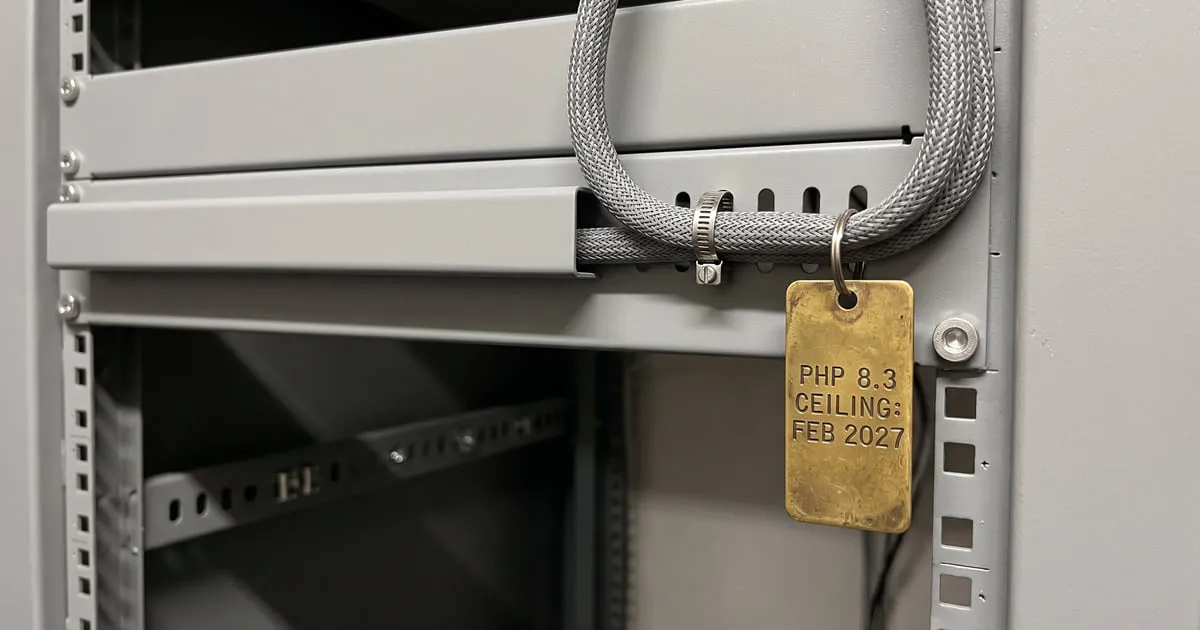
The newest PHP version doesn't set the target. Compare the candidate's security end with your next upgrade window, then with the chain's slowest link.